
You are eight weeks into a loading program. The pain has dropped from a 6 to a 2. You finally trust your calf, your knee, or your elbow again. And then the trip arrives: two weeks away, no gym, a suitcase that is already too heavy.
Here is the good news. Tendons do not need barbells. They need predictable, repeated load. That is it. A tendon responds to how hard the tissue is pulled and how often, not to how impressive the equipment looks. Which means a handful of small items, packed flat, can hold nearly all of your progress in place while you eat too much bread and walk too many miles.
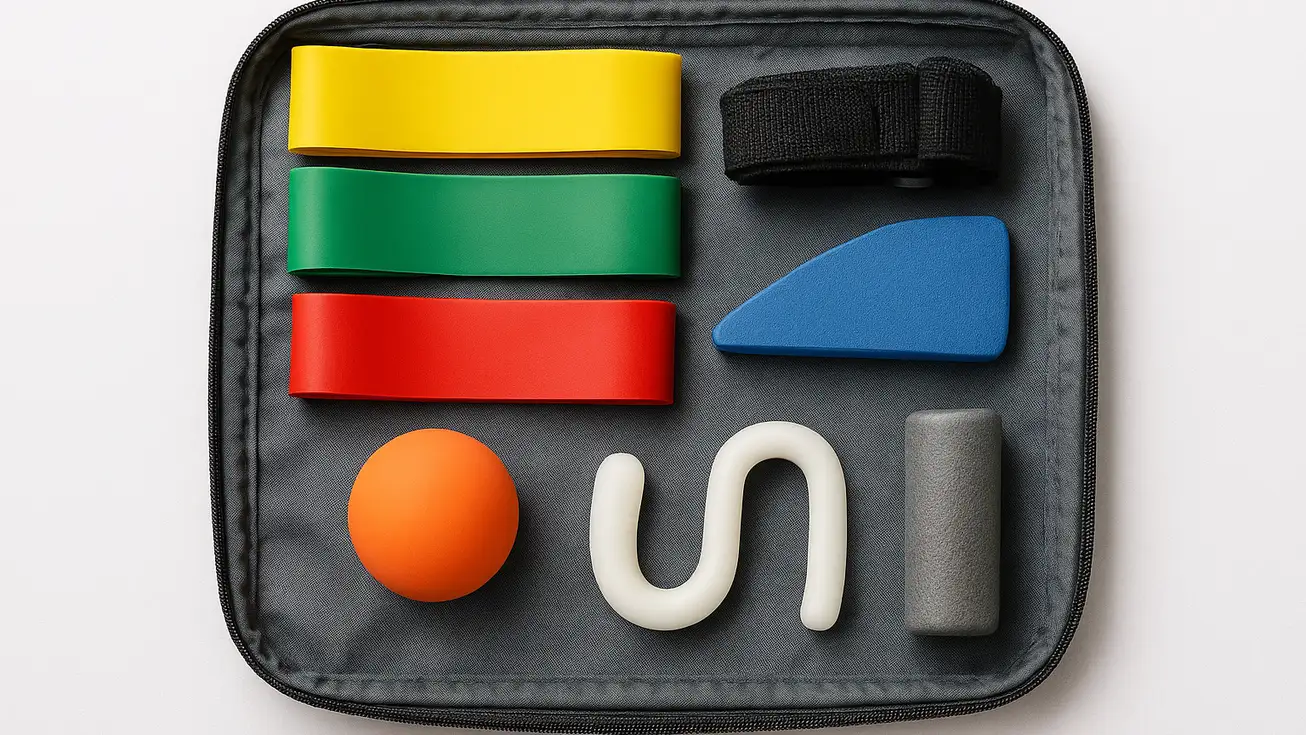
Below is a real kit. Everything fits in a packing cube, weighs under two pounds together, and costs about $35 if you shop carefully. Each item is paired with the exact job it does, so you are not carrying anything decorative.
Why Two Weeks Off Actually Hurts
Tendon strength does not vanish overnight, but tendon tolerance gets fussy fast. The tissue adapts slowly and de-adapts a little faster. Skip loading for ten to fourteen days while simultaneously increasing your walking by three or four times, and you have created the worst possible combination: less capacity, more demand.
That gap is where most vacation flare-ups live. It is rarely the one big hike that does it. It is the quiet erosion, and then the hike. Watch for the early hints that the balance has tipped, because warning signs your sightseeing marathon usually shows up before real pain does.
The fix is not ambitious. Research on tendon loading keeps landing on the same unglamorous answer: a few sets, most days, at a load your tendon respects. Ten minutes is plenty. You are not building. You are holding.
The Kit, Priced Out
Prices are ballpark and vary by brand, but this is what a functional travel kit costs. Nothing here is a gadget.
- Long resistance band, medium tension (about $8) - your main strength tool for calves, hamstrings, wrist and elbow work. Get a loop or a flat band around 40 inches so you can anchor it under a foot or a door.
- Heavy short loop band (about $6) - short, thick, awkward, and the best thing you can pack for hip and glute work that protects knee and hamstring tendons.
- Compact isometric strap (about $7) - a length of non-stretch webbing with a handle or two sewn loops. This is the sleeper pick of the whole kit. It lets you push hard against zero movement, which is how you get real isometric loads in a hotel room.
- Lacrosse ball (about $5) - for the calf, glute, and forearm muscles that get cranky from airplane seats and cobblestones. Not for the tendon itself.
- Adhesive felt heel wedges (about $5 for a pair) - drop them into your walking shoes to take a slice of strain off an irritated Achilles or plantar fascia on heavy sightseeing days.
- Flat furniture slider or thin plastic wedge (about $4) - a portable way to raise your forefoot or heel for slant board style calf and knee work.
Total: roughly $35. Weight: about 22 ounces. That is less than a paperback and a water bottle.
What the Daily Ten Minutes Actually Looks Like
Do this most days. Not every day, not perfectly. Five sessions across a two-week trip already beats zero by a wide margin, and eight or nine sessions will have you walking back into your first appointment home with nothing lost.
Set a timer. Put the TV on. This should feel almost boring, which is the point.
Minutes 0 to 3: Heavy Isometrics With the Strap
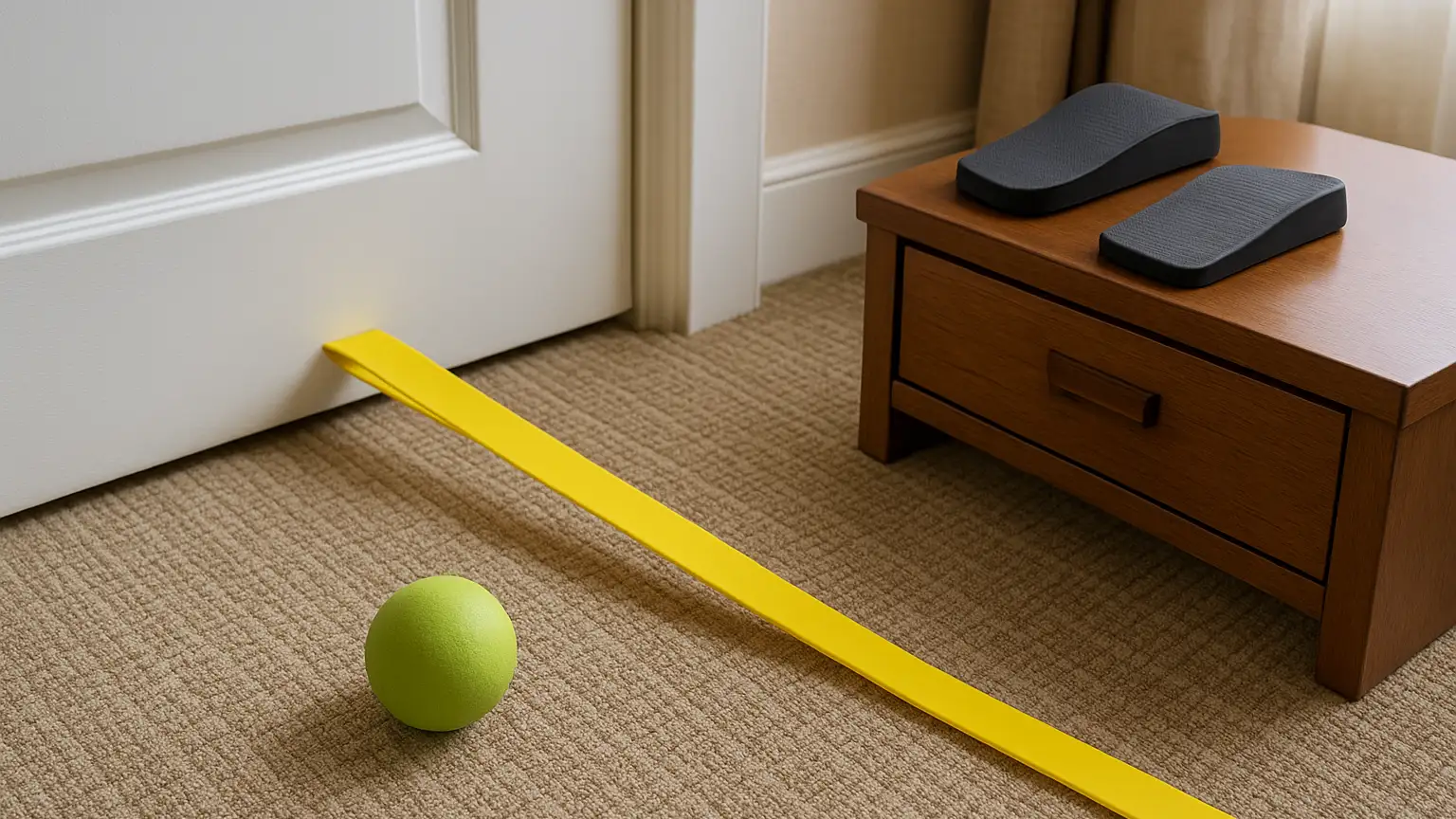
Isometrics are the most travel-friendly tendon tool that exists. No movement, no space, no noise. Loop the strap under your forefoot, sit tall, and press down into it as hard as your pain allows while your hands hold the strap still. For knee tendon issues, sit on a chair, loop the strap around your ankle, anchor the other end under the far chair leg, and press your shin forward against it.
Aim for four holds of 30 to 45 seconds, resting a minute between. Effort should sit around 7 out of 10. Pain during the hold should stay at or below a 3, and it should not be worse the next morning.
Minutes 3 to 7: One Slow Strength Movement
Pick the single movement that matters most for your tendon and do three sets of it. Slow tempo, roughly three seconds up and three seconds down.
- Achilles or plantar - single-leg heel raises with the forefoot on your slider or on the edge of a book, band looped over your shoulders for extra load.
- Patellar tendon - split squats with the band under your front foot and over your shoulders, or slow step-downs off the bottom of a stair.
- Hamstring tendon - band-anchored hip hinges, or a slow single-leg bridge with your heel dug into the carpet.
- Tennis or golfer's elbow - slow wrist curls and extensions with the long band, plus a heavy band squeeze held between your fingers.
- Rotator cuff and shoulder - band external rotations with the band shut in a door hinge, elbow pinned to your side.
Minutes 7 to 10: Muscle Care, Not Tendon Care
Roll the lacrosse ball into your calf, glute, or forearm for a couple of minutes. Roll the muscle. Grinding a ball directly onto a sore tendon feels productive and usually is not, and it can leave the area more reactive for a day or two.
Finish with a short walk-out. Stand up, take thirty easy steps around the room, and notice how the leg feels. That quick check is your data for tomorrow.
The Small Bag That Protects Months of Work
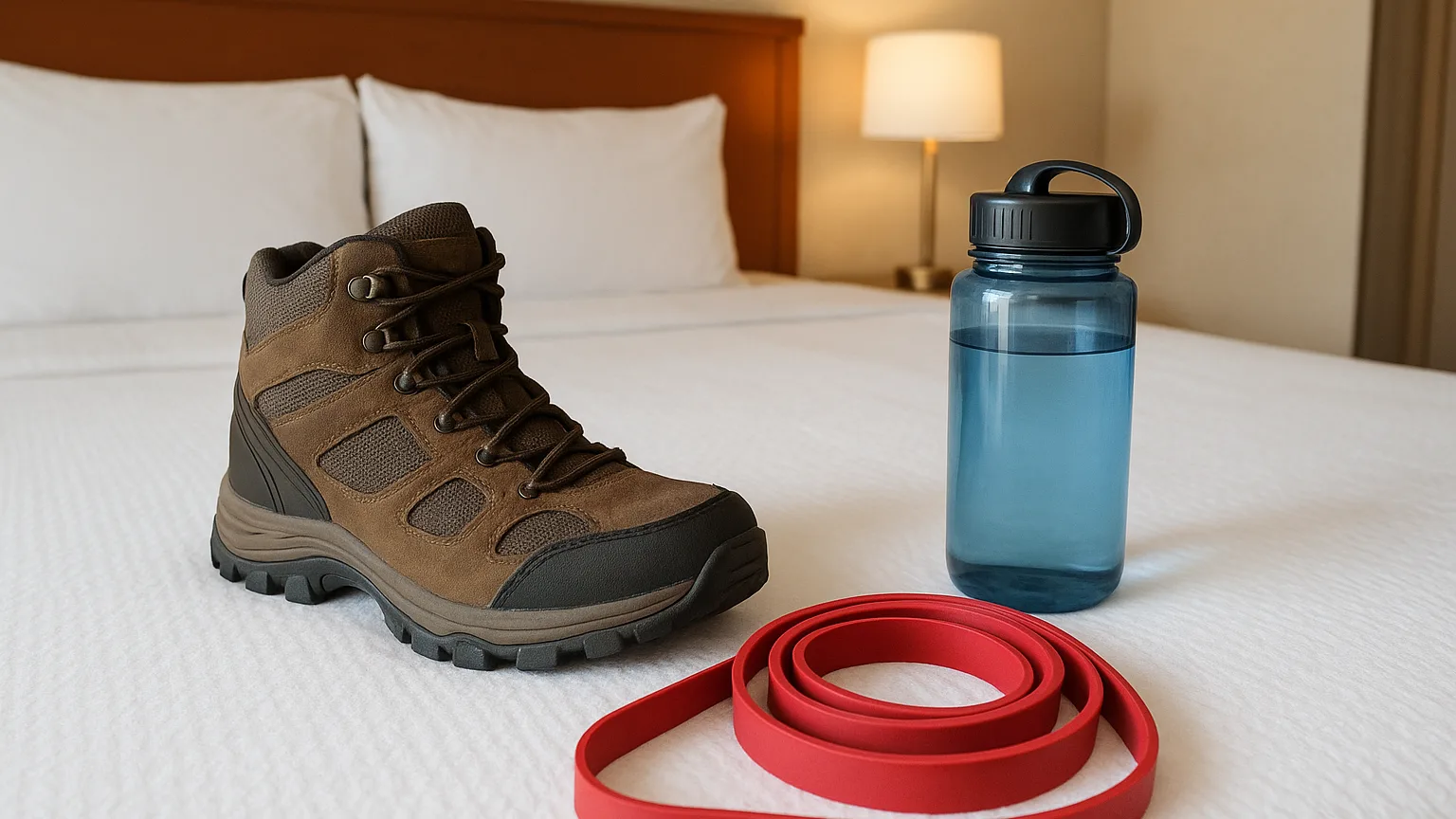
Tendon rehab has a reputation for being fragile, and it deserves some of that. Progress is slow to earn and easy to interrupt. But the thing that actually protects it while you travel is not discipline or equipment budget. It is a short, repeatable habit paired with six flat, cheap items: a long band, a heavy loop, a non-stretch strap, a lacrosse ball, a pair of heel wedges, and something to prop your foot on. Four heavy isometric holds, three slow sets of one movement, a couple of minutes on the muscle, and a walk around the room. Ten minutes, most days.
Match the effort to the day rather than the calendar, use tomorrow morning as your scoreboard, and be honest when a hill town day means isometrics only. Do that, and you come home with the same tendon capacity you left with, plus a lot of photos. Pack the kit before you pack the second pair of jeans. Your first session back will tell you it was worth the 22 ounces.
Tendon pain is slow to build and slow to settle
Start with the injury itself, then look at what treatment actually does for a tendon that has stopped healing on its own.